
Tom Trottier returns to routine after deep brain stimulation procedure
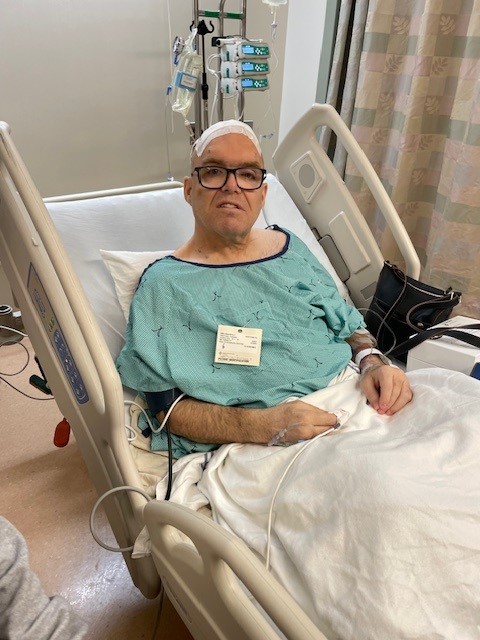
Tom Trottier recovers at HSC after DBS implant surgery. He was discharged the next day.
Much of Tom Trottier’s life has been shaped by seizures—not just the acute episodes themselves, but the physical and emotional exhaustion that follows. In recent years, Tom, 51, had been experiencing up to 10 seizures a month. For Tom and his parents, Pat and Phil, it’s been stressful and unforgiving.
But life for the Trottiers seems to be turning a corner, thanks to deep brain stimulation (DBS) implant surgery performed on February 6. The surgery, Manitoba’s first-ever DBS procedure for a patient living with epilepsy, was performed by neurosurgeon, Dr. Anton Fomenko.
“Tom was really tired of having seizures,” Pat Trottier says. “They affect everything—his energy, his mood, his whole sense of well-being. When he heard about the DBS surgery and understood the risks, he said, ‘Yes, I want to do this.’”
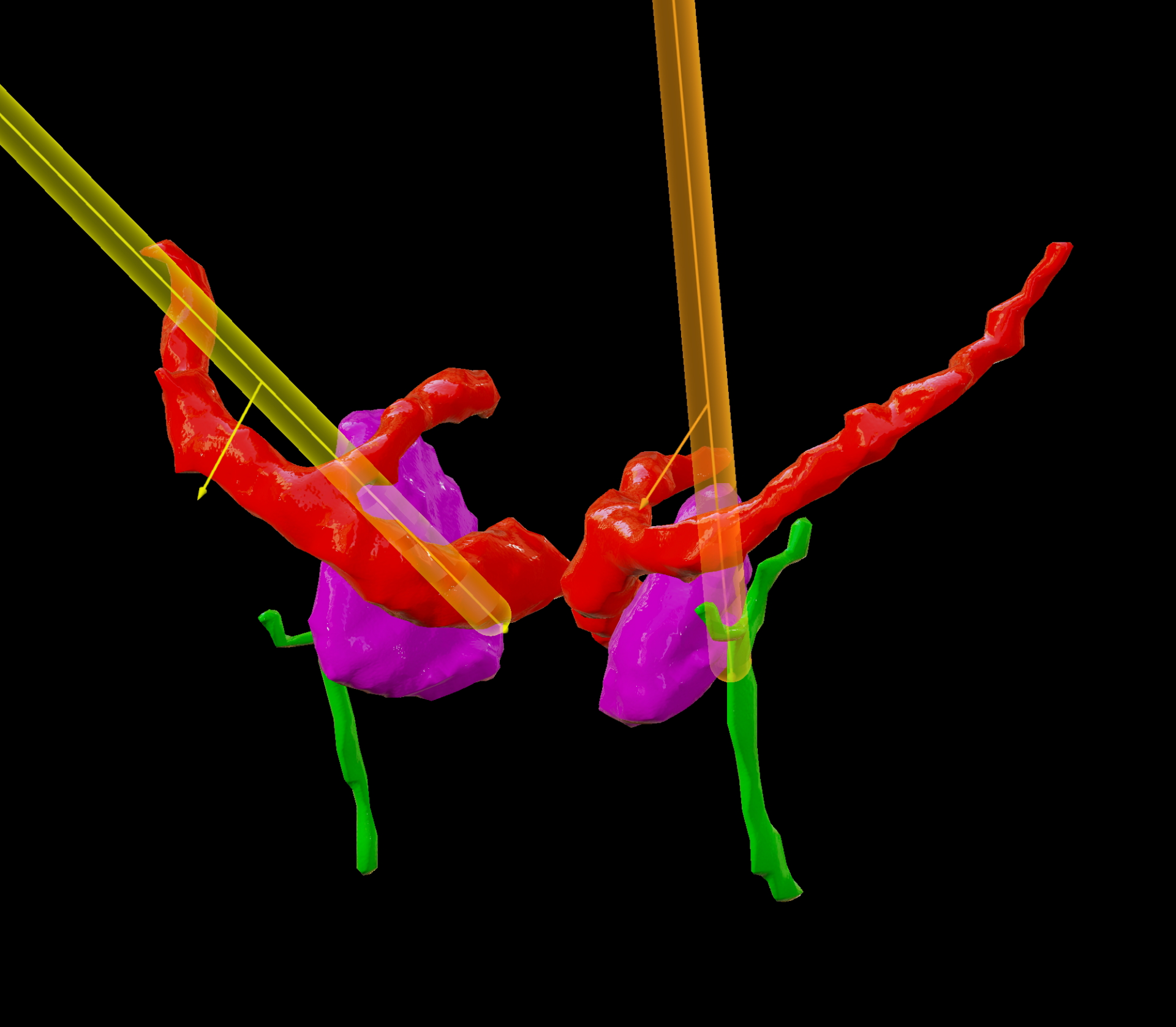
This is a 3D map of the electrodes used to treat Tom’s epilepsy. The purple spots (anterior nuclei of the thalamus) show where the brain is being stimulated to stop seizures. The red parts of the image are nearby blood vessels, and the green lines are other important pathways also known to modulate seizures (green).
DBS is a type of brain surgery that can help control seizures when medications alone are not enough. Thin, soft wires are placed in the thalamus—a brain region connected to seizure pathways—helping disrupt the circuits involved in seizures. These wires are connected to a small device implanted in the chest. The device sends carefully programmed electrical signals to help regulate abnormal brain activity, thereby preventing seizures. Early indications are that Tom’s surgery was successful. In the month following the procedure, he only had three seizures. As he’s monitored over time, there exists the possibility of reducing his medications.
Just as important are the subtle shifts in how he feels day to day. “Tom seems happier,” says Pat. “He’s getting involved again, wanting to help out. One day not long after surgery a plumber came by his apartment, and Tom put on an apron because he wanted to help. That’s who he is.”
Tom, who lives with an intellectual disability as well as epilepsy, has been steadily returning to his regular schedule, which includes swimming, physiotherapy, doing art projects, and setting up for Tuesday night bingos at the Transcona East End Community Club. He’s also a fixture at HSC, not only as a regular patient, but as a volunteer delivering newspapers to patients a couple of times a week.
“Tom is always happiest when he’s busy, when he’s helping, when he’s part of something,” says Pat.
He comes by it honestly.
Pat isn’t just the parent of a man living with epilepsy, she is a vocal, successful, long-time advocate for better care for the more than 23,000 Manitobans living with the condition, working closely with her fellow volunteers at the Epilepsy and Seizure Association of Manitoba and the organization’s Executive Director Sara Bettess. Among other outreach activities, she helped raise funds for the HSC Foundation to develop Unit B5B, which opened in December 2023 to increase capacity for patients recovering from neurosurgery, including epilepsy procedures.
“There are so many people living with epilepsy,” says Pat. “We need the resources, the specialists, the support systems. We’re getting there, but we have to keep going.”
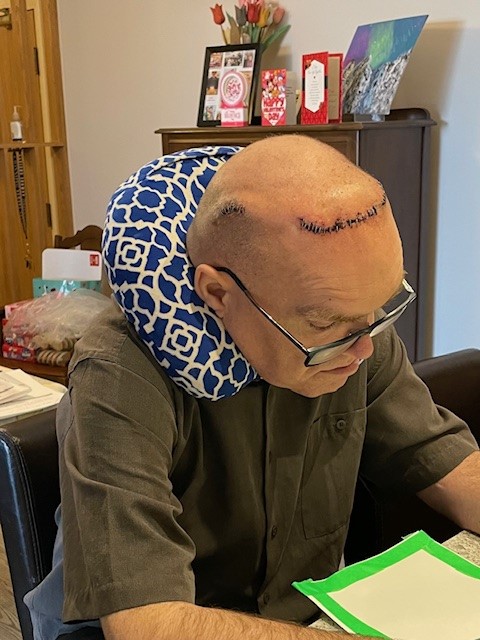
Not long after surgery, Tom Trottier was back to his artwork: “He tells people he had brain surgery and shows off the scars. He wears them like a badge of honour.”
While Tom recovers and his family looks forward to some easier days ahead, Pat is quick to thank the HSC community for the care he has been receiving for years. “Tom is healthy and alive today because of his care. Everyone at HSC sees Tom as a whole person, not just a patient. He’s been followed expertly by Dr. Marcus Ng and a dedicated epilepsy team, and the care provided by Dr. Fomenko and his surgical team was incredible,” says Pat. “Tom is pretty proud that he had the DBS procedure. He tells people he had brain surgery and shows off the scars. He wears them like a badge of honour.”
Your support helps excellence, innovation, and progress thrive at HSC—Manitoba’s hospital. To help HSC’s physicians, researchers, and health care teams provide even better care for Manitobans living with epilepsy and seizures, donate to the HSC Foundation’s Neurosurgery Research, Education, and Innovation Fund. Click here and select the fund name from the dropdown menu.
-by Stu Slayen