
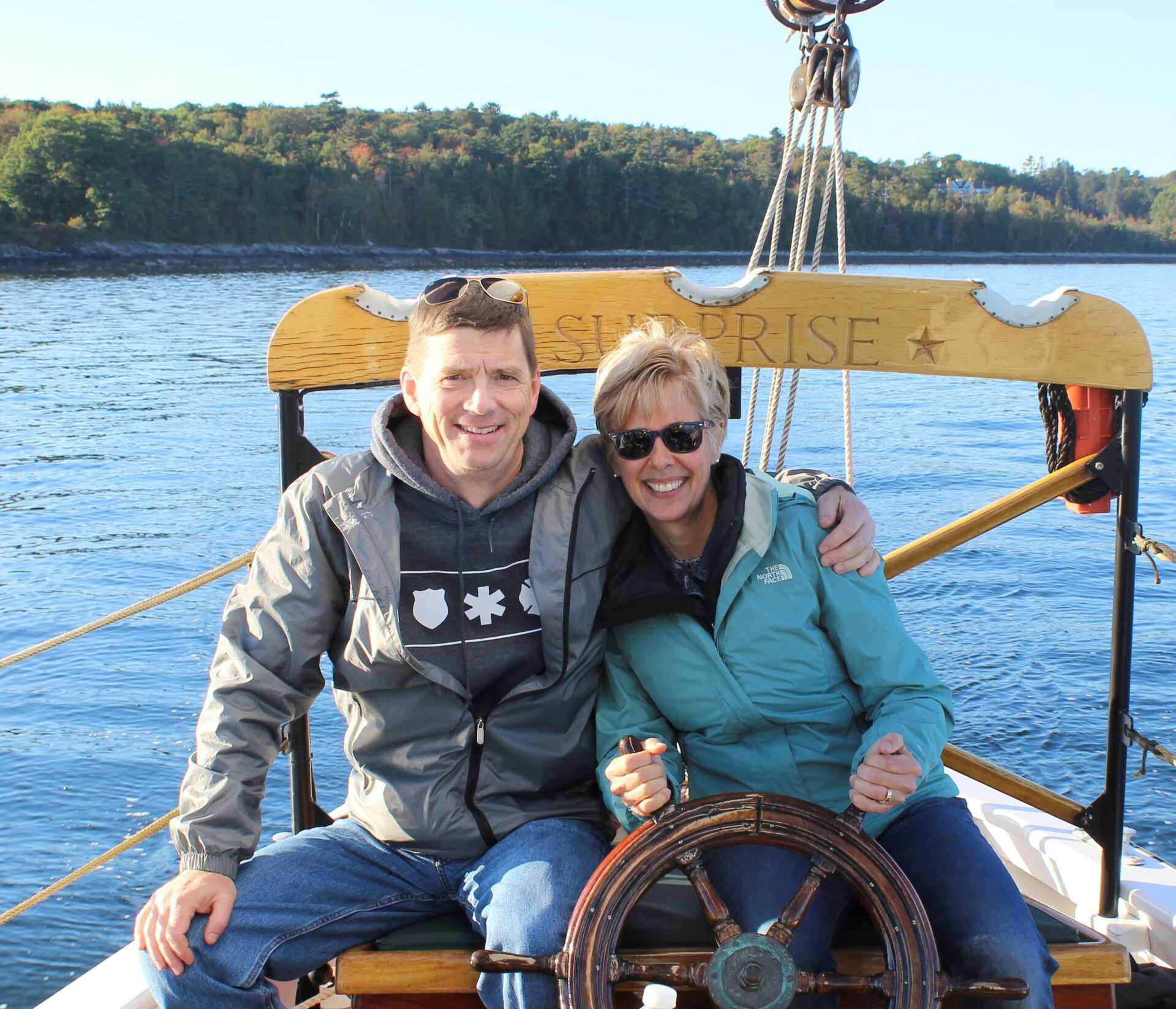
Len and Brenda Rust
Stormy day. Scary day. Fortunate day. Doris Day.
For Len and Brenda Rust and their family, March 6, 2006, was all of that and more. It’s a day they look back on with gratitude and even a couple of laughs.
Len woke up at about four in the morning with a pounding headache and wandered into the kitchen for a glass of water. He started to see blurry, zigzag shapes in his eyes, an aura of sorts. He assumed he was having his first-ever migraine. As an optometrist, he knew from his patients what the symptoms could be.
He headed back to bed but collapsed face first on the floor in the bedroom, which woke Brenda who called 911.
“After that, I just have kind of vague memories of ambulances and emergency rooms. I was in and out, mostly out,” Len recalls.
The ambulance took Len from the family home just outside Brandon to the community’s hospital. After a CT scan, it was clear that Len had an aneurysm and would need to go immediately to Health Sciences Centre in Winnipeg for emergency treatment. But it wasn’t that easy as southern Manitoba was facing a late-winter blizzard.
“They couldn’t get a flight out and some roads were opening and closing,” says Brenda.
While paramedics transported Len to Winnipeg, Brenda returned home, packed a few things, gathered their young daughters Lindsay and Beth, hopped into the car and put on a Doris Day movie for the girls while she drove the icy highway to Winnipeg, seeing more than a few cars in the ditch along the way. (“I don’t know why I even had a Doris Day movie,” she laughs in hindsight.)
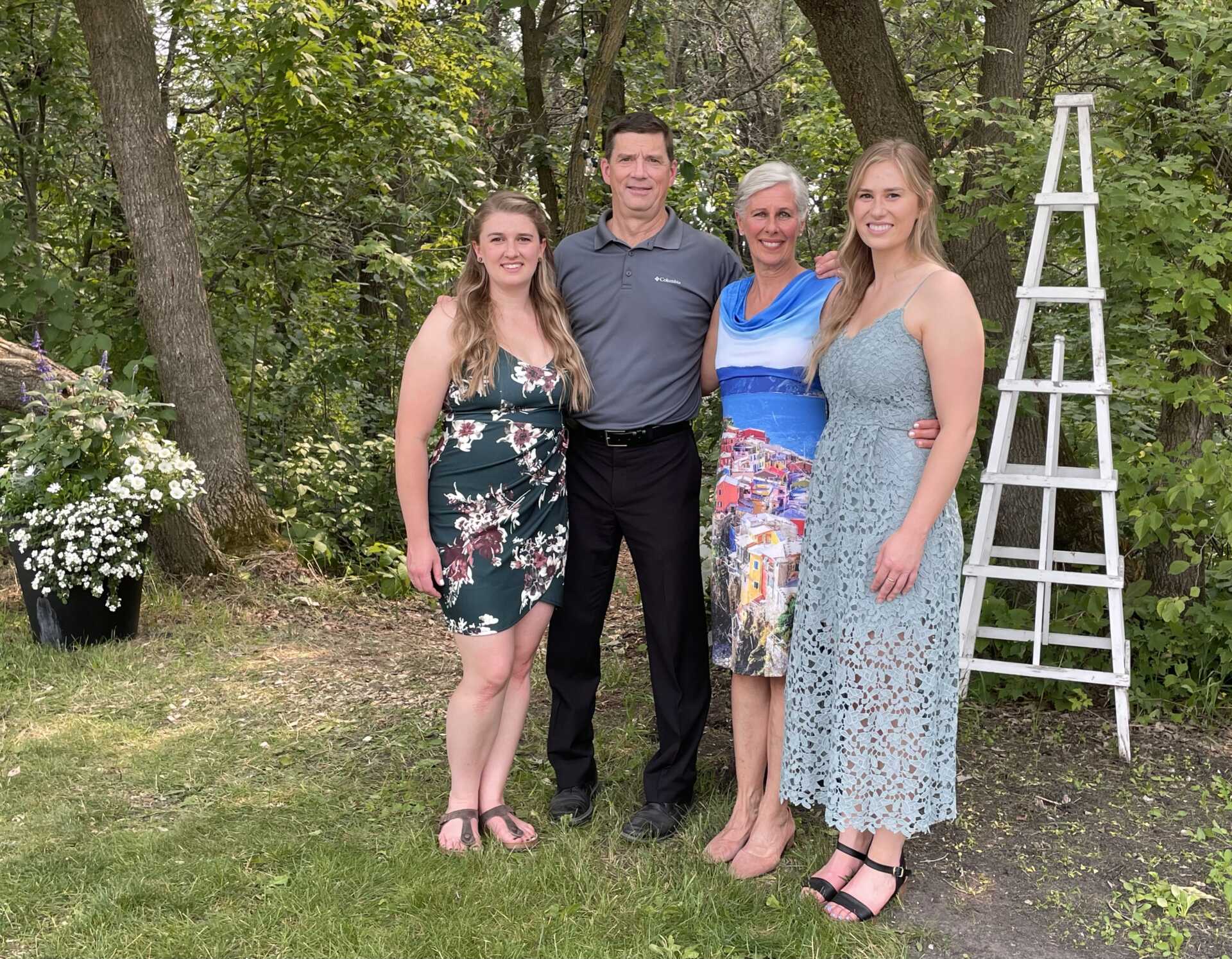
Len and Brenda Rust with daughters Lindsay (left) and Beth (right): “That first year after surgery was big…. Everything felt different,” says Len
HSC was waiting for Len and family, with legendary neurosurgeon Dr. Michael West meeting Len upon arrival. More scans and tests were ordered to inform the treatment he was about to receive and to make sure he was stable enough for surgery. By this point, they knew that he had a subarachnoid hemorrhage, meaning his aneurysm was bleeding.
Len continued to drift in and out of consciousness, but when the issue of consent for surgery came up, he was clear-eyed and alert: “His hand shot up from the stretcher. He said ‘I’ll sign it. Show me where!’” Brenda recalls with a chuckle. “It’s actually a funny memory for us.”
A short while later, Len was prepped for endovascular embolization, a minimally invasive procedure to address aneurysms by inserting platinum coils right into the bulging space to slow blood flow and increase clotting. During the procedure, the bleeding intensified unexpectedly. A “code blue” was called and medical staff leapt into action to save Len’s life.
This was no longer a minimally invasive case. To rescue Len, surgeons needed to drill a burr hole and perform a craniotomy (the temporary removal of a small piece of skull) to address the aneurysm and drain the blood from the brain. Dr. Scott Sutherland, Dr. Greg McGinn, Dr. Graeme Marchuk, along with Dr. West and others were involved in his care.
Despite the gravity of the situation, Brenda was confident that Len was in good hands. “I never dreamt for a moment that he wasn’t going to be okay,” she says. “I just knew it would work out.”
Len recovered at HSC for 12 days before being discharged. In the days and weeks that followed, Len experienced some short-term memory issues for a little while, along with some headaches and occasional numbness and tightness in his legs—all predictable and manageable side effects from his major surgery. He was able to return to work after six weeks and felt well physically, but the emotional side effects persisted.
“That first year after surgery was big. I must have had PTSD of some sort,” he says. “Everything felt different. I’d go to my daughter’s piano recital and find myself in tears.”
Over time, those challenging feelings settled into feelings of gratitude and lasting appreciation for the care he received and the people who made it possible.
“My heroes aren’t sports stars,” Len says. “People in health care are my heroes. Doctors, nurses, technicians, paramedics.”
Brenda, too, feels a lasting sense of gratitude. As a retired speech-language pathologist who coincidentally worked with patients recovering from strokes and brain injuries, she knows that Len’s recovery and their life together could have been much more complicated if not for the expert and timely care.
Instead, they are enjoying an active retirement in Onanole in a home they purchased over 15 years ago. They travel, they kayak on Clear Lake, and they enjoy an active social life with their friends, including frequent games of Texas hold ’em in each other’s homes. They also enjoy spending time with Lindsay, an ambulance dispatcher who lives in the community of Chater, just outside of Brandon; and Beth, a firefighter paramedic who lives right in Brandon. No surprise that Len and Brenda’s daughters chose helping careers just like their parents did.
For Len and Brenda, it’s a good retirement; a good life.
As an expression of their gratitude for the care Len received, Len and Brenda became monthly donors to the HSC Foundation many years ago, later deciding to leave a gift to the Foundation in their wills, thereby joining the Bannatyne Legacy Circle.
“During one of Dr. Sutherland’s many check-ins while I was recovering, I asked him: ‘When you saw me in the operating room, if you could’ve put a percentage on my chances of surviving like this, what percentage would that have been?’ Without a pause, he said: ‘single digits.’ I know how fortunate I was.”
“Once you realize the importance of HSC and the impact they have,” Brenda says, “you just want to support it. Adding the Foundation to our wills just made sense.”
“We were given so much,” Len adds. “This is just one way to give something back.”