
A mother, a son, a frightening crash, and the surgical technology that saved the day
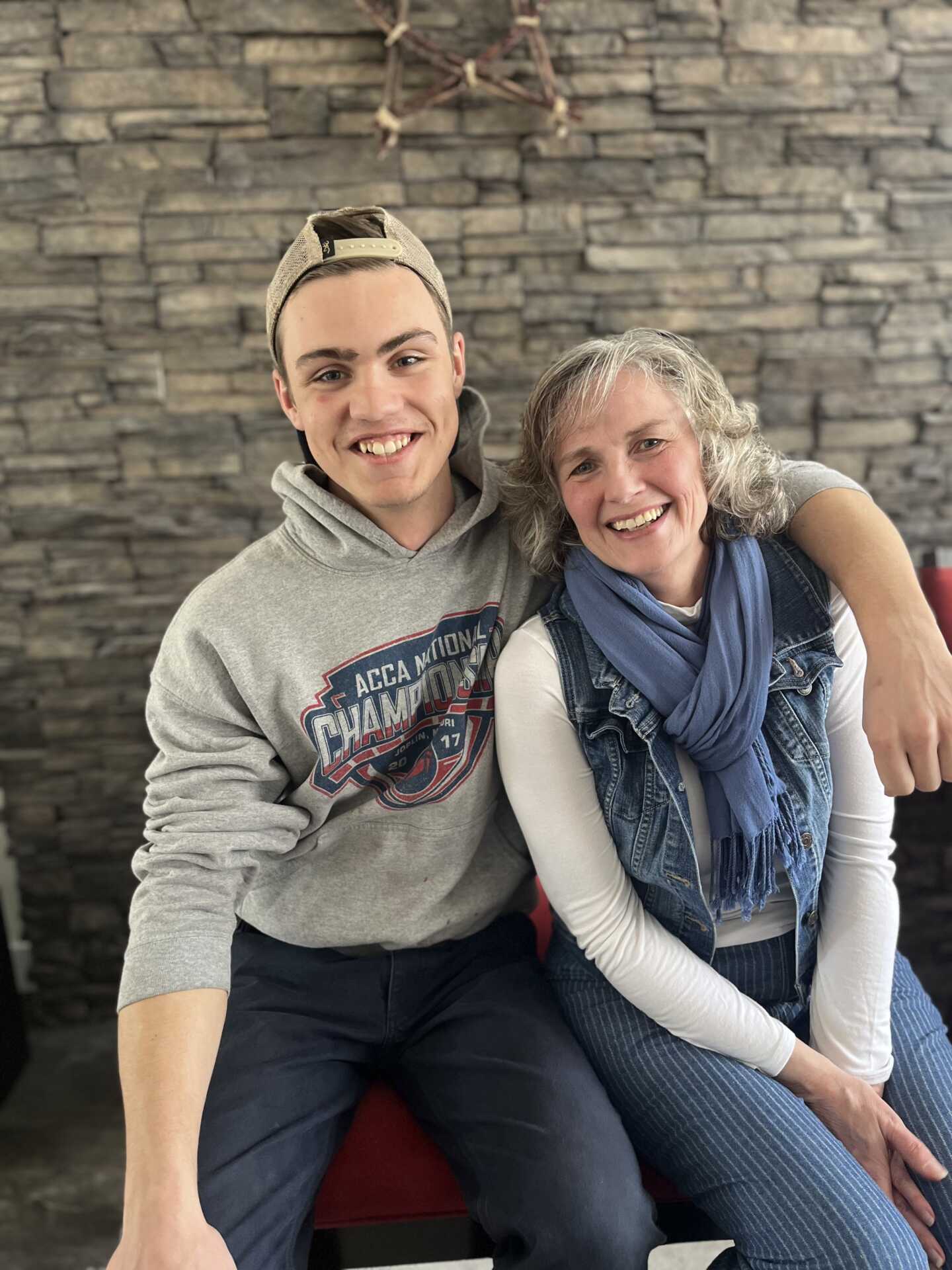
Pierre and Danielle Laurencelle: “The odds of what happened, the odds of how it all turned out, it doesn’t even make sense to me. But I think about it every day,” says Pierre.
On January 3, Danielle Laurencelle was behind the wheel on Highway 59 near Niverville, heading south for a family dinner. Her 17-year-old son Pierre was in the seat directly behind her; her daughter Christiane, and Christiane’s fiancé Kieran were on the other side of the car.
A driver in the oncoming lane suddenly turned across Danielle’s path, leaving her no time to react. Danielle’s vehicle struck the side of the other car, and the force of the impact sent both vehicles spinning into the ditch. Airbags deployed sending dusty powder everywhere.
“It felt like I had been crushed,” Danielle recalls. “It was shocking, but I could still move and still talk, so I figured it wasn’t that bad.”
Pierre remembers lying in the snow after crawling from the car, his adrenaline so high he felt no pain. A bystander came to his side and kept him talking while paramedics made their way to the scene. “She was really nice,” he says of the stranger. “It’s kind of nice to have someone talking to you when you’re lying there.”
First responders arrived fairly quickly, and all four passengers were transported to the hospital in Steinbach and then to Health Sciences Centre in Winnipeg, where the full picture of their injuries would become clear.
Christiane was examined and released. Kieran was admitted for several days of observation. But it was clear that Danielle and Pierre, who bore the brunt of the impact, needed surgery.
HSC spine surgeon Dr. Jay Toor assessed both patients and faced an immediate decision: which surgery to perform first? Danielle had a compression fracture in her lower back, requiring rods and screws. Pierre’s injury was more serious: fractured vertebrae with compression of the spinal cord. The choice was clear.
“Pierre was a millimetre away from being paralyzed,” Dr. Toor explains. “There’s no recovery from that. We had to act quickly.”
Dr. Toor and his colleagues used donor-funded navigation and imaging equipment, and it made all the difference in Pierre’s care and recovery. Dr. Toor performed a minimally invasive percutaneous procedure on Pierre, placing the stabilizing rods and screws through his skin, rather than opening the tissue surgically. The difference in recovery is significant. Cutting into the soft tissue surrounding the spine can cause greater blood loss and muscle trauma, and cause joints in the spine to fuse together which would have led to mobility challenges and a lifetime of stiffness and discomfort. Because Pierre’s screws were inserted through the skin, the surrounding structures were left intact.
“There is no way to do this without that equipment,” Dr. Toor says. “It lets us see inside the spine in three dimensions and place the screws with precision.”
Pierre was in surgery by early morning. Danielle followed immediately after, treated with the same minimally invasive equipment. Less severe than Pierre’s injury, but still significant. She went under anesthetic knowing her son had gone before her and that his surgery went well. “I asked them, ‘are you the ones who operated on my son?’” she recalls. “They said ‘yes’, and they told me what a nice boy he was. As his mom, I was just beaming.”
Mother and son spent ten days recovering at HSC, in the same room. “That was a godsend. We could hear each other’s voices and keep each other company.”
Physio began the day after surgery. It was brutal at first, Danielle admits—just sitting up at the edge of the bed required enormous will. But together, Danielle and Pierre got stronger.
The most significant news came at a follow-up appointment a few weeks later with Dr. Toor. Pierre had been quietly bracing for a difficult future characterized by arthritis and pain. Pierre had been thinking through what that might mean for his desire to learn trades and become a general contractor.
Dr. Toor put Pierre at ease. If all goes well (and so far, so good), Pierre will have his rods and screws removed in December. Then, after a six-month recovery period, he is likely to regain full mobility with no injury or surgical side effects on the horizon.
“I was like, no way,” Pierre says. “I completely did not expect that.”
When Danielle heard about Pierre’s prognosis, she thought of what Dr. Toor had told her in hospital: “He said if the accident had happened two years earlier, before the equipment arrived at HSC, the outcome would have been entirely different.”
Pierre thinks about the accident often. The striking image of his compressed spinal cord (which Dr. Toor showed him on an X-ray) is etched upon his mind. Knowing how he is feeling today and knowing that his long-term prognosis is very good, that image triggers feelings of gratitude as opposed to alarm.
“I feel more blessed than stressed,” says Pierre. “The odds of what happened, the odds of how it all turned out, it doesn’t even make sense to me. But I think about it every day.”
Danielle and Pierre will likely spend this Mother’s Day together doing their physiotherapy exercises and reflecting with appreciation on the expert care they received, and the donor-funded equipment that is making an excellent recovery possible.
The surgical navigation and imaging equipment used in Pierre and Danielle Laurencelle’s care— the Stryker Q-Guidance system and Ziehm intraoperative 3D imaging system—was made possible through donations to the Health Sciences Centre Foundation. To support ongoing research, innovation, and excellence in spinal care at HSC, please support the HSC Foundation’s Neurosurgery Spine Fellowship Fund. Please donate today.