
Researchers recruiting for HSC Foundation-funded study
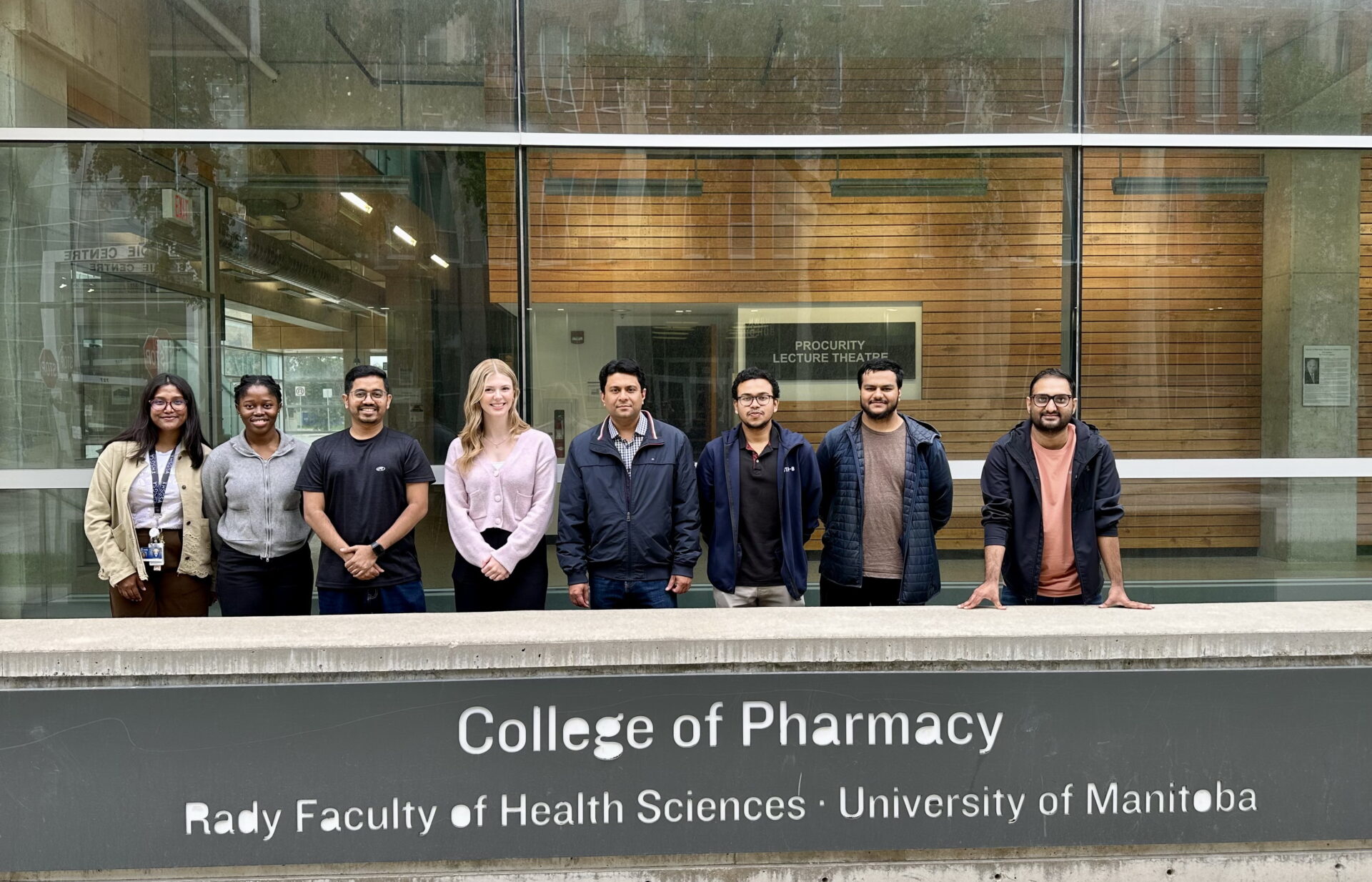
Dr. Abdullah Maruf (fifth from left) and his research team: “If it’s changing the medication or dose, or causing fewer side effects, it’s helping patients,” says Dr. Maruf.
An innovative tool for informing psychotropic drug prescriptions—any drug that alters brain and mood—could offer more effective treatment for Manitobans and lower health care costs by shortening hospital stays for psychiatric patients. This is the rationale behind a pharmacogenomics feasibility study led by Abdullah Maruf, PhD, and Dr. Jitender Sareen in Manitoba, in collaboration with Chad Bousman, PhD, from Calgary.
“Pharmacogenomics (PGx) is the study of how individual genetics can impact drug response,” explains Dr. Maruf, a pharmacist and assistant professor of clinical pharmacogenomics at University of Manitoba’s College of Pharmacy. Two individuals can take equivalent doses of the same drug, but their genetic dissimilarity could result in significant differences in how they metabolize it. “You could be a fast or slow metabolizer,” says Dr. Sareen, a psychiatrist and professor/department head of psychiatry at University of Manitoba. “If you have a liver chugging it away quickly, the body sees less of the medicine. If you have a genetic profile where you can’t metabolize it, you have side effects; it’s too much.”
PGx testing doesn’t inform about drug efficacy, Sareen clarifies. It reveals which ones are likelier to produce negative effects for a patient. This can guide medication selection and dosing, reducing the number of trials to find suitable medication. It can also guide deprescribing drugs that aren’t helping or are having adverse effects. And “there’s literature showing pharmacogenomic testing can reduce length of hospital stay,” he says. “Hospital days are very expensive.”
With abundant drug options, it can take months, even years, of trials for some patients to find medication that helps. Others experience adverse effects to trial medication, become discouraged from taking it, so don’t benefit from it. PGx testing can mitigate these challenges by determining likely responses to medications.
The PGx-Support study was granted $70,000 from the Health Sciences Centre Foundation. Open to inpatient and outpatient participants, the grant covers testing for psychiatric inpatients at HSC. The goal is to produce evidence to support publicly funded PGx testing at HSC. Private testing costs patients, on average, $500, although some insurance companies cover that cost.
The study’s primary objectives are to determine feasibility and utility of a free PGx testing service for HSC inpatients. Feasibility would demonstrate PGx testing is achievable and useful; a criterion of feasibility is a two-week turnaround—clinicians would receive results within two weeks of test administration.
Utility would demonstrate PGx testing benefits patients: “if it’s changing the medication or dose, or causing fewer side effects, it’s helping patients,” says Dr. Maruf.
Recruiting throughout 2027, study participants must be adults, referred by their clinicians, have provincial health care numbers (PHINs), and have no history of liver or bone marrow transplantation. Drs. Maruf, Sareen, and Bousman hope to recruit 100 HSC inpatients for the study (covered by the HSC Foundation grant) and 100 other participants from across Manitoba. More information about eligibility and enrollment is available here.
The PGx test is free to study participants, safe, and non-invasive: a simple swab of saliva. Patients will be tracked for several months following PGx testing to determine whether the patient’s condition is improving or causing fewer adverse effects.
American and European studies show up to 20 percent of patients will benefit from PGx testing. While the study focuses on psychotropic drug testing, PGx testing can guide prescribing for other groups of medications including oncological, cardiovascular, and pain management. “The potential is pretty broad,” Dr. Maruf says.
To support innovative research at HSC, visit our donation page and choose “Research at Health Sciences Centre” from the dropdown menu. Investments in health care research made today help enhance care for all time.
By Leslie Malkin