
HSC-led study proves brain procedure’s impact
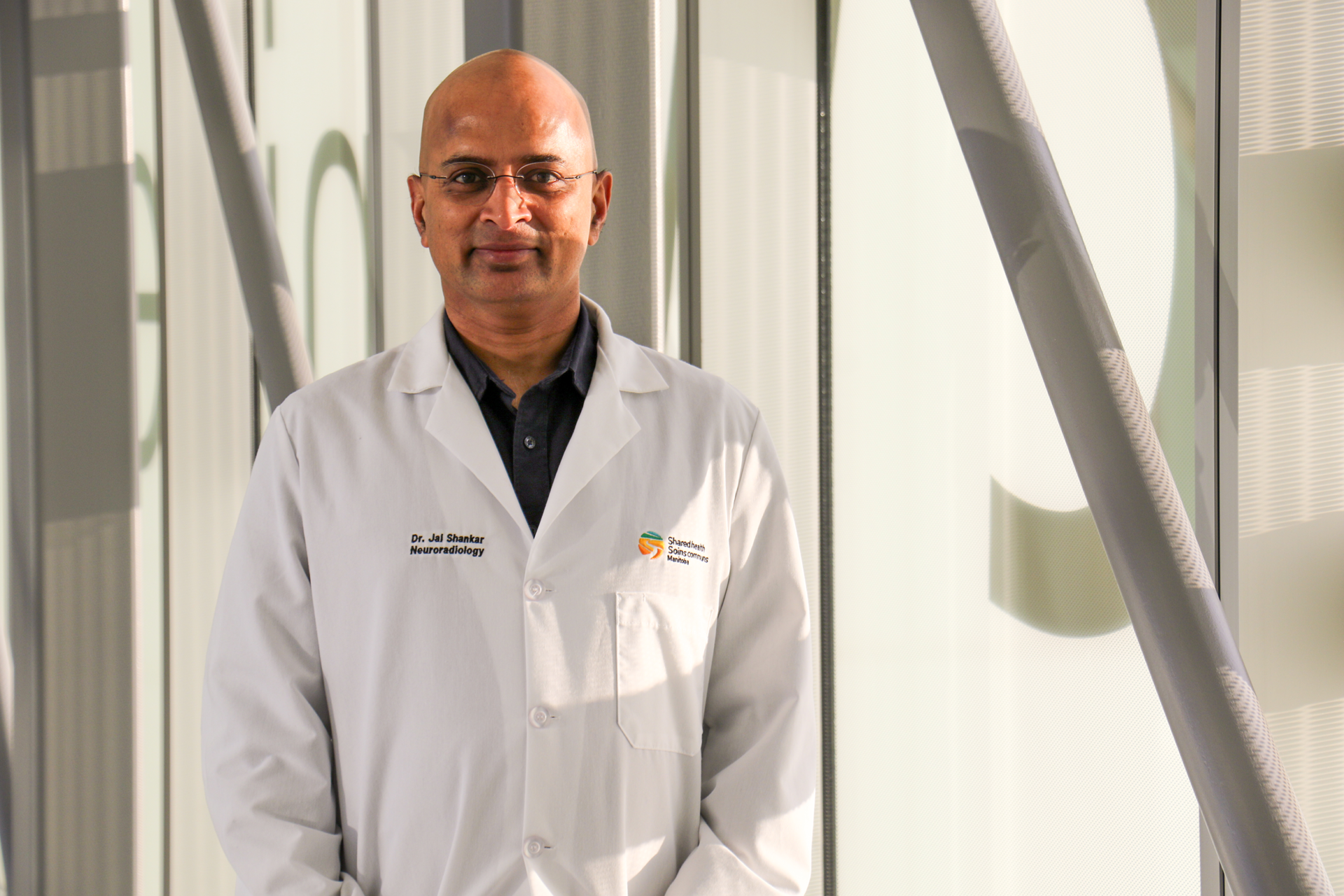
Dr. Jai Shankar, interventional neuroradiologist at HSC Winnipeg.
A research project based at HSC Winnipeg is poised to change care for patients who experience chronic subdural hematomas.
A subdural hematoma is a slow bleed that occurs between the brain and the skull, usually, but not always, after a head injury. In non-injury cases, it disproportionately affects older adults and can cause symptoms that resemble a stroke, including weakness, confusion, and difficulty speaking. Surgery to drain the blood has been for the standard treatment for decades, but the condition can become chronic, returning in about a third of patients, often within the first two months.
That high recurrence rate is what led Dr. Jai Shankar, an interventional neuroradiologist at HSC, to design and lead a major Canadian study examining a procedure known as EMMA: embolization of the middle meningeal artery.
The EMMA procedure is designed to address the source of the problem. Using advanced imaging and tiny catheters, physicians seal off a small artery that feeds the fragile membrane responsible for repeated bleeding. A glue-like plastic polymer blocks the blood supply, significantly reducing the chance that the hematoma will return.
“This approach has been used in medicine for a few years,” Dr. Shankar explains. “What was missing was the highest level of confidence and evidence showing how effective EMMA really is.”
To generate that evidence, Dr. Shankar designed and led a large randomized controlled trial. The study, which was launched in 2021, enrolled 192 patients at nine sites across Canada, with more than half treated at HSC. All patients received standard surgical care, but half also underwent the EMMA procedure.
The results were compelling. Patients who received EMMA had a dramatically lower risk of recurrence. About four percent of patients who underwent EMMA experienced a recurrence of a subdural hematoma, compared to roughly 28 percent in those who received surgery alone. For patients, the study firmly establishes EMMA as a way to improve recoveries and reduce the risk of recurrence and long-term disability.
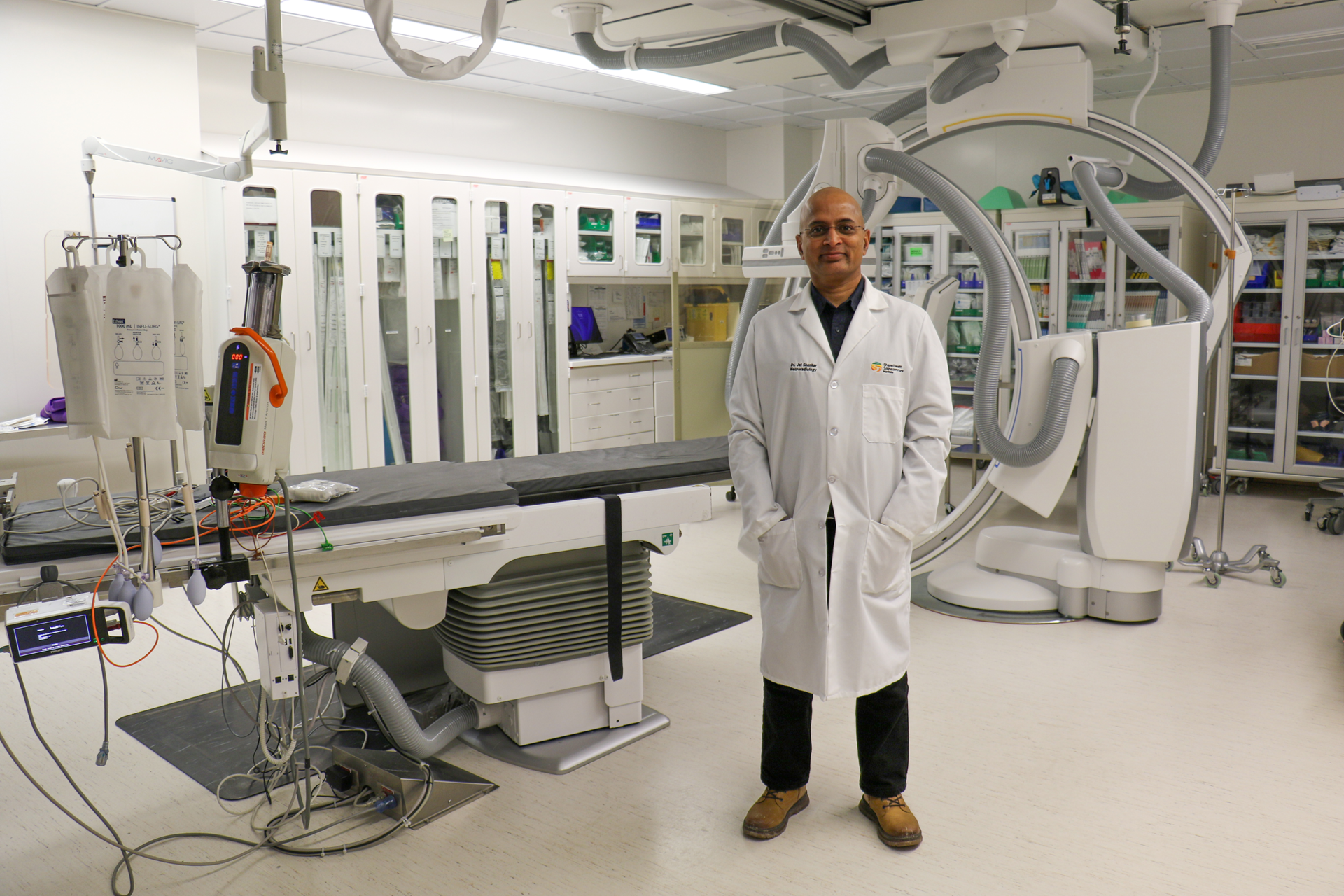
Nearly every component of the study, including patient enrollment, imaging analysis, and data management, was coordinated in Winnipeg, drawing on local expertise at HSC and the University of Manitoba. That structure allowed the research team to analyze results within weeks of completing patient follow-up.
Dr. Shankar presented the findings in October 2025 at the World Stroke Congress in Barcelona, Spain, where they attracted significant international attention and positioned the study to influence care well beyond Canada.
All EMMA procedures at HSC are performed in the Paul Albrechtsen Interventional Radiology Suites, a state-of-the-art facility funded by a landmark gift to the HSC Foundation by the late Paul Albrechtsen. That investment not only supports life-saving patient care, but also enables HSC to lead research that will shape medical practice. The suites have been operational since 2020. Watch a short video about the space.
“It is rare for Winnipeg to host a multi-site, randomized controlled trial,” notes Dr. Shankar. “Having the Paul Albrechtsen Interventional Radiology Suites made it possible in this case.”
Click here to read Dr. Shankar’s paper, ‘Management of Chronic Subdural Hematoma With Adjunctive Embolization of Middle Meningeal Artery: The EMMA-Can Randomized Clinical Trial’, which was published in the Journal of American Medical Association in April 2026.
Read the story of Philip Lee, C.M., O.M., who was treated for a subdural hematoma and then with EMMA at HSC.
You can support Dr. Shankar’s important work with a donation to the Jai Shankar Neuro Research and Education Fund. The fund was established in 2018 to support Dr Shankar’s neuroimaging and interventional neuroradiology-related activities at Health Sciences Centre by purchasing equipment and funding research, education, and training in neuroimaging and related procedures. Donate today by calling 204-515-5612 (or 1-800-679-8493, toll-free) or by visiting our donation page.